Showing posts with label Future. Show all posts

Saturday, September 10, 2011

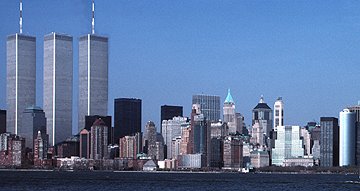
World Trade Center 3001

Build a virtual time machine and travel back to September 10, 2001: the day before the twin towers fell. Take along with you a list of all the planes that crashed and the passenger lists. Underscore the names of the terrorists on each list. From the 101st floor of one of the towers, fax the list to major newspapers, radio stations, as well as the FBI, CIA and the White House. Cause all major airports to be shut down until the Towers are emptied and guarded.

When the Towers fail to fall on the following morning, go forward in time to September 11, 3001. Stand at the base of the Twin Towers and look straight up at the aging and abandoned towers that stand as a monument to your time traveling achievement.

Instead of documentaries about the destruction of the Twin Towers, only what-if movies will be filmed about what almost took place.

Origionally published in Northern Lord vs. Southern Lord blog (http://realjesuscristo.blogspot.com/2006/10/world-trade-center-3001.html?m=0)
Published with Blogger-droid v1.7.4

Sunday, August 15, 2010

Adventist Futurist Blog Begins

Adventist Futurist, a new blog devoted to Adventist Futurism, was launched on August 14, 2010. The first post states that the purpose of "Adventist Futurist, is to collect, organize and coordinate past, present and future articles regarding Adventist Futurism." Another reason for this new blog is to trace, when possible, the origins and influences of Adventist Futurism." The blog header specifies that the blog will concentrate on futurology, futurism, science, aesthetics, ethics, space exploration, cybernetics, and other forward-thinking areas of study.

Friday, July 30, 2010

Macrolife, Space Colonization & Adventist Futurism

Adventist Futurists and their supporters may soon be in a unique historical vantage point and, with planning, can continue to be at history's cutting edge for many years to come. Adventists are growing at a healthy rate and, within the foreseeable future, will be at a unique juncture in human history as a force to be reckoned with as trend setters. The following is one of the vehicles that Adventist Futurists can utilize to effectively shape history on a larger scale than they have previously impacted it.

First of all it's important to note that Macrolife is based on real science. Macrolife is the vision of Dandridge MacFarlan Cole who "saw the human race as being at a turning point, corresponding to the adolescence of an individual, in which humanity would either destroy itself or come to a collective state of maturity and relative stability." [1] Additionally, Cole "was known especially for promoting the idea of colonizing the asteroids, or 'planetoids' as he argued they should more properly be called. The planetoids could be hollowed out, or actually inflated to create a bubbleworld with habitable space on the inside. The resulting space arks could orbit within the solar system, or be sent out on interstellar expeditions." [2] For a significant update of Cole's prescient vision consult the link below titled Islands in Space: The Challenge of the Planetoids, the Pioneering Work of Dandridge M. Cole. [3]

Some may not see what Macrolife has to do with the gospel commission to preach the good news that Jesus Christ died, rose again, and is returning to rescue those he loves from a dying world. Traditionalists focus on Christ's immanent return which Adventists have been hoping for since 1844. If, and this is not meant disrespectfully, Christ does not return by 2044, the fact that 200 years will have elapsed since Adventists started looking for Christ's return should force another assessment as to his delay. If Christ's coming can be delayed 200 years, it is not inconceivable that it could also be delayed another 100 or 200 years. What am I getting at? Humanity is capable right now, on a limited scale, of beginning the move into other worlds. Humanity lives in space right now, on a limited scale, on the International Space station. With the proper resources and vision, it can be on its way to making Macrolife a reality by 2044.

Christians are very far geographically today from whence they originated. It would have been astounding for early Christians, who did not conceive of a round and far-flung world, to envision the full extent of the Earth and how far Christianity would travel in the next 2,000 years. Christianity has even transcended the Earth itself as there, no doubt, have been astronauts who believed, and continue to believe, in Christ Jesus as their savior. Who is to say that this Earth is the limit of where Christians and their supporters can live and still await Christ's return.

References:

1. "Extraterrestrial Colonies," Navigation, No. 7, Summer-Autumn 1960, p. 85.
2. Dandridge MacFarlan Cole
3. Islands in Space: The Challenge of the Planetoids, the Pioneering Work of Dandridge M. Cole

Related posts:

Noah's Interstellar Ark, Future Worlds, Creating an Ideal World, Christianity 3001 A.D. Adventist's New Horizons, Adventist Futurism

Friday, June 18, 2010

How to Find a Near-Perfect Spiritual Group Experience

Imagine a group where everyone feels part of the group even when they are not. It is the main purpose of the group to welcome each new and continuing member. Every effort is made to address each participant's needs. Some may think it is too intrusive for the Adventist Futurism Fellowship to be so concerned with every need a member or visitor might have. For these individuals this concern about too much intrusiveness is also perceived as a valid need.

The first time one enters through the doors into an Adventist Futurist Fellowship seminar one wonders why no one had ever alerted him or her before to the outstanding cornucopia of benefits that one finds when one is welcomed into this unique group. Some find this somewhat elusive knowledge of the group as having a quasi-Gnostic quality in that knowledge of this group seems like--though is not in reality--an awareness or perception that is only available to the initiated or chosen few. That is not the case at all. What then is the source of this esoteric quality that renders this group almost invisible to the public-at-large?

The fellowship of the Adventist Futurists, or the initiation into Adventist Futurism and all its tantalizing benefits is that no one--or very few at any rate--can find information about the Adventist Futurists as one would when searching for similar groups. Some claim that they have found easy entry into the society of Adventist Futurists when what they stumble upon is one of the illusory doors that are meant to keep out the merely curious.

Only those who are dead-set on finding this once-in-a-lifetime experience and fellowship will ever find it. It is not understood by some why entry into the almost esoteric society is made so difficult. If the benefits of the Adventist Futurists are as valuable as are reported by those who have once participated, but for some reason, did not remain, then why the difficulty in gaining access into this quintessential group?

The answer may never be completely known. However, it appears that the commitment that each member of the Adventist Futurists has for each of his brothers and sisters is so complete--if one can classify the endeavor to fulfill each participant's every need as an attempt to confer completeness in this life--is taken so seriously, that only the true devotee can ever find and enter into this exquisite group of people.

I myself was serendipitously welcomed into the camaraderie of the Adventist Futurists some time in the recent past, but took a wrong step once inside and thought it preferable to venture outside the group and find my own way in the world. It is my earnest desire to once again--if they will accept me--gain entry into the beneficent care of the Friends of Adventist Futurism.

It is my hope that you too will somehow find your way into the indescribable society where each need is almost anticipated before it is fully expressed.

Friday, August 21, 2009

Noah's Interstellar Ark

Hurricanes in Florida, terrorism in New York City, earthquakes and wildfires in California, tornadoes just about everywhere, global warming, raging wars in Afghanistan and Iraq, and genocide in Darfur. The harsh realities of living anywhere on planet Earth hint that there are no desirable cities or countries left to live in. Why bother moving out to somewhere else? Why not consider moving up! I mean that literally, not figuratively

Noah in the Bible was not given a ready-built mode of survival from the catastrophic flood that wiped the known-world into oblivion. He had to build the ark himself. In like manner this is what must be done by Adventist Futurists and their supporters. There is nowhere to escape in the event of a worldwide conflagration but up and out. Humanity possesses the God-given science, vision and the means to build arks in space to escape Earth's destruction by fire.

If Noah and his family had to begin again from scratch after they escaped death by water into a virtually new world, a postdiluvian one, why might not modern-day Noahs also escape into a virtual new world beyond the disaster of a worldwide Apocalypse?

Yes, Christ still returns, but not to Jerusalem on Earth, but rather, to a spiritual Jerusalem on another world or sphere. All the prophecies of the Bible may need to be cast in new settings to adjust to unforeseen glitches ushered in by the postmodern world in which we live.

We've all heard the expression of not putting all our eggs into one basket. We must not disregard the possibility that the damage or dangers that have been perpetrated on Earth by humanity, or by problems endemic to life-on-Earth, may be irreversible. There may be hope yet. We need to act in undreamed of ways. We cannot wait to see the Earth dying with no solution at hand. Planning for alternate versions of deus ex-machina may not be such a bad idea after all. How true would the saying then be that "God works in mysterious ways."

Sunday, August 09, 2009

Future Worlds: Theoretical Adventisms

First-day Adventists believe(d) that Christ's coming was going to occur very soon. They are one of the primary groups that grew out of William Miller's preaching toward the middle of the 19th century. As their name states, they observed the first day of the week, Sunday.

Seventh-day Adventists are one of the descendants of the previous group and most distinctly worship on the seventh day of the week, Saturday. There are some other distinctions which we cannot go into detail at this time.

(Eighth-day) Adventist Futurists are a conceptual society. They believe that not only is the seventh day the day of rest, but additionally, they observe the hours after sunset on Saturday night and ending with sunrise on Sunday morning, as well. They focus on the spiritual beauty of the Sabbath and not on the strict letter-of-the-law. (This does not necessarily mean that 7th-Day Adventists do not also focus on the spiritual beauty of the Sabbath.)

(Eighth-day) Adventist Futurists have as one their primary goals to escape planet Earth's eventual human-engineered destruction by escaping to habitable worlds within this solar system and, eventually, to worlds surrounding nearby stars. Progressive (Eighth-day) Adventist Futurists go one step further and observe any 24-hour period commencing on any day of the week at sunset and concluding at sunset on the following day because this will be the norm when the weekly cycle will cease to be meaningful. The sun never sets in outer space.

Perfect Futurists are theorized as being the descendants of the (Eighth-day) Adventist Futurists when they have successfully engineered Macro Life worlds which can exist in-between worlds and are said to be the eventual and preferred living environments for space-faring humans. [Scientist Dandridge M. Cole originated the term "Macro Life" in his 1961 book The Ultimate Human Society.]*

Please see Adventism's New Horizons for more in-depth treatment of this future society.

* "Cole conceived Macrolife as a possible next step in evolution, potentially as momentous as the transition from single-celled to multicelled life. Units of Macrolife, self-contained human societies in planetoid colonies or elsewhere, would have the capacity for growth, motion, reproduction, self-repair, and response to external stimuli.[12] He developed further details in his 1961 The Ultimate Human Society and in subsequent books."

http://en.wikipedia.org/wiki/Dandridge_M._Cole

Sunday, July 26, 2009

A Third of the Trees are Dying, Literally

CCD (Colony Collapse Disorder) is currently causing bees to completely disappear by 2035. With the bees gone fruits, vegetables and nuts will be gone, as well, since bees--not wind--pollinate these crops. Humanity would need to survive only on wind-pollinated crops like wheat and rice. While humans have survived during past historical periods on a non-varied diet, optimum health and quality of life as we know them now, will be a thing of the past. While humans may survive the loss of all fruits, vegetables and nuts, many animal species which depend on these foods will not survive. If the wind-pollinated crops also become endangered--which is certainly not impossible--starvation will quickly take its toll on humanity.

As I watched this PBS documentary, The Silence of the Bees, the text from Revelation came to mind right away and these words haunted me the more I watched as the mysterious dying of the bees was explained.

. . . "A third of the earth was burned up, a third of the
trees were burned up
, and all the green grass was burned up."
Revelation 8:7 (New International Version)

Supposedly, malnutrition, parasites, pesticides, and finally, a virus are to blame for a third of the bees having already died out quickly. While this may explain this phenomenon partially, no available solution has been found to reverse this loss of bees. While this may explain the mystery of the dying bees, it does not answer as to why it's happening in what appear to be apocalyptic proportions.

If the bees disappear--and they will die out by 2035 unless a way is found to reverse the process--most of the foods we eat will also disappear. When the food disappears, more and more humans may very well start to experience ill health and then die, even in civilized countries. With the death of more and more of humanity, untold problems will appear, e.g., riots, revolution, and the break down of civilization.

Yes, science may yet save the day, but if it cannot, then we may be witnessing the gradual extinction of humanity or we may be seeing something else.

What if the End, the apocalypse spoken of in the book of Revelation, is really upon us?

During the Cold War it was nuclear destruction that was feared. How much simpler will the end be ushered in: by the dying of the bees and everything that follows in its wake.

Pray that the bees live on, as well as all of life and its interconnectedness. If you can't pray for that, then pray for yourself and your family that you will survive the long-foretold End of all things.

Friday, July 10, 2009

Creating an Ideal World: Adventist Futurism

What would an ideal world be like? How would you bring it about? Before anything can be achieved it has to be envisioned first.

Computers, spacecraft, the Internet--the list goes on and on--first had to be conceived before they could be invented and perfected. As unlikely as it seems, had Jules Verne never written From the Earth to the Moon (1865) which depicts a rocket launch from somewhere in Florida, no one would have gotten the idea to make that vision come to pass a hundred years later.

What is not being done now that could improve the world beyond recognition? There must be something that either has to be added or removed before a new reality could take place. We could wait for it to come into existence on its own. While not impossible, perhaps implementing a think tank of sorts to bring about an ideal reality might achieve more than simply waiting for something that may take millennia, or perhaps may never take place.

We should pool our best minds from every nation and work towards an approach to perfecting reality in as little time as possible.

I'm reminded of the vision of Isaac Asimov in his Foundation series (Foundation, Foundation and Empire, Second Foundation.) In order to avoid a long decay into barbarism, efforts were implemented to shorten the decay of the galactic empire to only 1,000 years. Why can't something similar be done to solve the major problems of our present reality?

What are some of the greatest challenges to an improved reality? Eliminating war, poverty and hunger are the first things that come to mind. Others might be providing education, medical care and a place to live to everyone on our planet. The third phase would be addressing environmental problems, managing natural phenomena such as hurricanes and earthquakes. Finally, the greatest gift we could give our world reality would be to take measures to move beyond our sometimes fragile planet and seed the known universe with our people, our technology and our dreams.

One possible approach might involve a little-known group of people. It's as if they had almost been kept a secret from the rest of the world for some grand vision of enhancing reality. Adventists are some of the most educated people in the world because they have higher education and progress as one of their cardinal principles. Adventists may very well be some of the most wealthy people in the world when you factor in of all their collective capital. Next to the Catholic church Adventism is the richest church in existence. This is not a widely-known reality. It would be easier for a future-oriented think tank to rise out of the Adventist Futurists than from any other traditional body.

Tap into the unknown power of your mind and literally create an ideal world.

We're here for a special God-given purpose: to better the world.

For a related post please consult Adventist Futurism.

Friday, May 08, 2009

Christianity 3001 A.D.

What will Christianity look like in 500 or 1,000 years? While Christianity can still be integrated into past manifestations of its history, no matter how modern or contemporary it has become or is becoming, it is not necessarily a given that the distant future of this religion will be as recognizable as its past has been.

Some of the realities that may well come to pass in the future will, no doubt, also have their impact on Christianity. Some of these are briefly described below.

Christian cyborgs - A cyborg is a being that is composed of both cybernetic as well as organic components. To a limited extent cyborgs already exist today as technology works wonders with those who have had limbs amputated due to war, disease or other mishaps. When a future individual becomes more cybernetic than biological--perhaps some even out of choice--how would this reality impact its experience as a Christian? In such a case the person in question would be more a work of man than a work of God. Of course, it would still be God who gave humans the knowledge to enhance or refashion one of his creatures. Would cyborgs be the only ones who could share their faith with other cyborgs? How would they fit in when worshiping among biological Christians? Might not the ultimate symbol of their acceptance into the community of believers be a painting of Christ washing the feet of a Cyborg apostle at the last supper? Paul's familiar text about there not being neither slave nor freeman, Jew nor gentile, male nor female, may very well one day include, neither biological person nor cyborg. All are one in Christ.

Christian A.I. (Artificial Intelligence) Entities - Some may scoff at the mere mention, but keep in mind that earlier generations had similar attitudes toward in-vitro humans, as well as the still-forbidden cloning of human beings. If one day A.I. persons can pass for human or accomplish most human activities except anatomical reproduction of offspring, how would Christianity deal with these seemingly improbable humans? They would be perhaps one of humanity's greatest scientific accomplishments. Already one can carry on conversations with proto-humans via computer that sometimes jars one's mind as how human they appear in their thought patterns and approaches. If free-will is built into these A.I. Christians, might they not also seemingly want to relate themselves both to the God of its human creators and to their designers themselves? Could these A.I. Christians also be considered one in Christ?

Interplanetary/interstellar Christians. These are not so unlikely as one might think. In a hundred years or less, when Christians are born on Mars or the moons of the gas giants, how would they relate to their savior who will not only come for those he originally promised to retrieve at the end of Earth's history, but to their off-world descendants who also have a hope in the return of Christ. Centuries later when humanity leaves its solar system behind, what will Christ's return to Earth mean to those who are light years from Earth?

Thursday, March 05, 2009

Remember the Future

The future wasn't supposed to be like this. There was supposed to have been only one great depression. Technology was supposed to have made it easier for humanity to pursue the finer things of life: research, space exploration, learning, altruism, and an endless stream of marvelous approaches to life.

There are, of course, different visions of the future. Not all Sci-Fi writers or futurists painted a golden futuristic age. There are enough possible dystopias to go around as far as those who like imagining negative visions of the future. The dismal world imagined in the Matrix film series is only one example of the worst possible vision for humankind. Might not the current obsession with experiencing reality via social network sites, as well as virtual reality programs such as Second Life, not be as close an attempt to live in the alternate reality of the world-within-a-world that is force fed into the minds of the sleeping masses of humanity that the Matrix films present?

Hopefully, things will return to normal in a year or two--or ten. If things continue the way they are now, and we somehow grow to accept that the future turned out quite differently than we imagined it would be, then how nostalgically we will long for the imperfect past of the 1960s or 1990s and their relatively golden prosperity.

Some religious individuals are gleefully celebrating that things are getting worse. They believe that the final prophecies are coming true and that a new order of things will be ushered in, after the grim realities that are just beginning to come to pass take their expected course. They believe that after the darkness seems to be gaining the upper hand, then the light of the new kingdom will make any momentary darkness worthwhile.

I, for one, have never been able to rejoice when bad things take place, no matter what good might come of it. I hope and pray that we can all continue living our lives of progress, plenty and possibility. In the mean time, I will keep my eyes fixed on the being that engineered all of reality, good or not-so-good. In the final analysis, whatever happens next year or next century is what he allows.

In the meantime, enjoy every breath, every ray of sunshine, every fragrant flower. These are gifts in good times and bad ones that God has blessed us with.

Friday, October 24, 2008

23rd Century Adventist Futurism Conceived

After the collapse of world financial systems sometime in the 21st century, those Adventist Futurists who had hidden technology when there was money to be had, left Earth far behind on ark-like vessels.


Back on Earth the situation was bleak for a hundred years. After that time this is what the Earth looked like:


Clones were the second class citizens this time around.

Saturday, May 10, 2008

The Second Coming of Christ: Reinterpreting the Prophecies

The first coming of Christ was nothing like what the Hebrew nation expected. It did not set them free from Roman rule. It did not usher in the peaceful and successful world that they had read about in the book of Isaiah.

If this misunderstanding happened with the all-important First Coming of Christ, what would prevent a similar misunderstanding from happening to the as-important, Second Coming of Christ.

When it is said that "every eye shall see him" one has to keep in mind that when those words were written down "every eye" referred to those in the then-known world, ostensibly a flat world with the Mediterranean, or great sea, as it's focal point. The Second Coming would have to be very large in scale, millions and millions of angels to fill a large enough area of the Mediterranean Sea, and the barbarian areas of Europe, Asia minor, etc., to be able to be seen all over the then-known world. It would follow then, that when the Second Coming occurs it will be seen by every eye in that part of the world. As the Earth rotates other areas will also be able to see the wondrous sight of golden beings and their Saviour-King hovering over planet Earth in a chariot of clouds.

Greater study and prayer are needed to unlock the prophecies about the Second Coming of Christ and strip them of interpretations that 2,000 years have built into them.

Some faiths believe in a Secret Rapture. Ours does not. However, when it speaks of "one will be taken and the other left" I sometimes wonder if out of respect for Free Will, those that are not taken will be allowed to live out their lives, as well as that of their descendants, until Free Will eventually renders this planet unlivable. In this way, God would not be the destroyer of those he created, they would destroy themselves. How long would this planet continue to exist without God's protecting grace preventing total anarchy and evil?

Some might think that to allow this world to continue with the uninterrupted intensity of evil that would exist without God's grace cushioning the effect of sin, would be more unkind than to destroy all those who reject God's last call to repentance. The same might well be said for our present state of affairs where an ever-increasing level of evil and suffering continues day after day.

Thursday, April 17, 2008

The End of Time

This is a phrase that comes to mind without any thought on my part. It doesn't help that often when I open the bible it opens to Ezekiel 7. The New International Version editor has titled this chapter "The End Has Come." I can't tell you how often my bible has opened as if automatically to this very page. I've often thought that perhaps it is the very center of the binding and therefore the page finds me instead of me finding it. That can't be quite right as it took me several tries just now to find this chapter. I had not remembered that it was the seventh chapter. There are, however, 48 chapters to skim through, yet it took about a minute or three to find this End Page.

I've read this chapter several times, especially every time it just happens to find me. I've thought that God guides me to this page and yet it's historical specifics don't resonate with me. My end of time obsession is far in the future. When I don't automatically think of these words, "the end of time" I often think of the following phrase: "a million years from now."

I meditate on what life or the universe will be like within a million years. Sometimes I associate both of these automatic mind phrases and imagine that life as we know it, or the universe, will end a million years from now.

It is nothing but a suspicion. It is not a wish I want to come true.

Today I stopped to think what meaning the cessation of time, as one of the four dimensions of existence, would possibly have. It sounds nonsensical that the other three dimension, height, depth, width could possibly go on and yet, the most important one, time, come to an end.

I once read in a scientific article that it is thought by some that time was the first dimension to come into being before the others could possibly exist. It makes sense since whether you believe in God or not, the universe started out as nothing, or close to nothing, an imperceptible original point of matter-energy. Since time was the first to come into existence, why couldn't it be the first to cease existing, after which the other dimensions would follow its lead.

The good news is that our universe might very well be a cyclical one. If time ends a million years from now, it can begin again a million years later. Or perhaps after time ends, it automatically begins again, racing faster and faster to its next End Game.

Saturday, March 08, 2008

One Million Members Added to Adventist Church Yearly

Through non-human means, the amount of new members is reaching incredible heights. Even though the human has to cooperate with the divine, nevertheless, some new principle is at work in the mission camps and older traditional sites of Adventism.


With the increase in numbers come new challenges, as in some locations, Adventists are no longer in the minority. Efforts are being made to counteract any dangerous influence on the part of political magistrates who now control most of the courts in some lands.


Disclaimer: The above is an example of anticipatory journalism. It expresses the desired outcome of a near-future event on the part of the writer. It is intended in the best possible way. If such outcome does not materialize, time then becomes important as to determine the eventual realization of the desired reality.

Wednesday, December 12, 2007

Future of God

Alternate title: Future of God and Humanity

When God said let us create humankind in our own image, did we or did we not inherit emotions or states of mind such as wonder, surprise, excitement, awe, hope, optimism, and other positive human qualities? What I'm getting at is that these good qualities had to come from God; we did not develop them ourselves. Therefore, what is so illogical about a God who also gives himself the luxury of experiencing awe, wonder, surprise and hope? Or is our God a being that has always been devoid of surprise, wonder, and exploration? I realize I'm seeing the man in God and not vice-versa, but are we not created just a little bit lower than the angels?


This may sound shocking to some, but it reassures me, in a way. Why do you suppose God created--had to create so many of us--at such a great cost? Think of the impossible although, of course, when you think of it, nothing is ever really impossible. What if we all are God's insurance of perpetuity in the same way that parents' offspring are insurance should they somehow never live out their full life span?


Why did God give so much in Christ to save us, mere flesh and blood? Might he not have more at stake then just some wayward children who needed rescuing at any cost? If you really believe that humans are children of God, then like human children eventually becoming like their parents at some future time, might we also not have been designed with the potential--perhaps millennia from now--to become as perfect as our creator through the self-actualizing gift he stored in our very DNA? It's not easy to even write these words. Nevertheless, the very idea gives me a strange hope and sense of well-being for the future of humanity on planet Earth, as well as any non-terrestrial colonies humans may yet develop in worlds beyond our own.


Finally, and this takes lots of faith and courage, what if, we are now, or may one day come to be, all that's left of the perfect and self-sacrificing being we commonly refer to as God? We not only owe it to ourselves to take care of each other and of our home planet, but we also owe it to him, our creator, God.

Tuesday, September 11, 2007

SPACE RAPTURE: Extraterrestrial Millennialism and the Cultural Construction of Space Colonization

I schoogled (Google Scholar) the terms "Adventist Futurism" and one of the titles that caught my attention was the one in question.

George E. Vandeman's Planet in Rebellion appears in his bibliography.

Page 107 of this dissertation:

Seventh-Day Adventist evangelist George E. Vandeman saw the Earth itself as threatened by mankind’s technology and believed the Day of Judgment, along with mankind’s extraterrestrial rendezvous with Christ, were not far off. However Vandeman's Adventism championed the Earth even as fundamentalists championed the above. After Sputnik, Vandeman wrote, America "was a nation in shock… We realized that we were actors in a technological revolution that would dwarf every other revolution into insignificance." Vandeman noted that only fourteen years separated the destruction of Hiroshima from the crash landing of the Soviet Lunik II spacecraft on the surface of the moon. "We had touched the universe," he wrote, "and its broken secrets had plunged us into nuclear and moral fear."

Vandeman believed that the immense technological advancements of the past few decades were a sure sign of the approaching "end to this world as we know it." Echoing the apocalyptic beliefs of other end times preachers, Vandeman asked, citing the Book of Revelation, "Could it be that we are approaching the time when God must intervene to ‘destroy them that destroy the earth’?" Space colonization would be a reality, for Jesus was the first to prove it could be done. "It was Jesus Himself, you remember, who demonstrated the possibility of space travel and promised it to His followers," Vandeman wrote. "The laws of gravitation were circumvented as the Lord of glory was swept heavenward." When Jesus returned to the Earth, "past vast constellations, bursting into view with a brilliance of display…" he would whisk his believers into heaven, where they would wait out the purification of the Earth by fire. Vandeman noted that none of this miracle would require space suits or oxygen tanks. 154

154 George E. Vandeman. Planet in Rebellion. Nashville: Southern Publishing Association, 1960. pp. 137-49.

To read the entire dissertation click on the title of this post or please click on the link below:

http://www.lib.utexas.edu/etd/d/2004/mcmillend92689/mcmillend92689.pdf

Tuesday, August 14, 2007

What is Real? Anything?


When I first read about the idea that we might be a computer simulation I thought that it was a bit much and that someone had nothing better to do than speculate about the nature of reality. It's odd that all of this speculation goes hand in hand with cutting-edge technology. If one day, lets say, science perfects teleportation, then that will become the paradigm with which to redefine reality, or what we think reality is.

If one day we're here one moment and light years away in a flash, philosophers might start to wonder if we were ever here to begin with, or if when we got to where we were going would we still be the same person, or would we ever be that person again, if we teleported back from whence we came.

Of course even Plato questioned whether this was the true reality or whether it was a shadow of the ideal model somewhere in some perfect sphere beyond our reach. I've sometimes thought that the apostle Paul must have read much of Plato when he spoke of "looking through a glass darkly."

Please click on the title of this post to read the original New York Times article, Our Lives, Controlled From Some Guy’s Couch, by John Tierney that got me to thinking about the views I've expressed here.

Monday, August 13, 2007

Temporal Mechanics


If you live in the past you will die there.

If you live in the present you will live out your life normally.

If you live in the future you will live forever.

Thursday, August 02, 2007

Designing your Own Eternity

"As a man thinketh, so is he." Proverbs 23:7

"If death is not extinction, what might it be like? That’s a question the Harvard philosopher Robert Nozick, who died five years ago, enjoyed pondering. ... Although his reflections were inconclusive, Nozick hit on a seductive maxim: first, imagine what form of immortality would be best; then live your life right now as though it were true." -- Jim Holt, Eternity for Atheists, New York Times Magazine, 07.29.07

Yes the Bible says this and the Bible says that. I'm grateful for what it says, and more importantly, for what it doesn't say. It leaves out so much information. So much the better. We have minds and we have imagination. Let's use them creatively to make eternity the wildest, most regarding and incredible reality we want it to be for ourselves, and for those we love.

My own version of eternity is a bit like this. And it keeps on changing all the time.

This may sound bizarre but I've had this thought forever. Death is so ugly to many of us that I want the luxury of dying in heaven. Yes that's an oxymoron. But let me explain. If you die in heaven, you will live a second later. In a way this is the most perfect kind of death. Virtually, of course, it is a non-death. If you're dead for only one second, are you really dead? What constitutes death, anyway? My ideal death in heaven would be in a coffin of light. When I awake, right beside my coffin of light, is my smiling savior, who gave me the luxury of being dead for only one second, in--of all places--heaven itself.

I'd love to travel back in time once I've entered eternity and sample, first hand, all the major moments of past human history, including the very creation of the universe. I'd also like to travel into the far future. But not just any future, but the future as it might never exist, had God not intervened in some future point in time. Anything unpleasant I'd witness I'd want to forget an hour after I had witnessed it.

Living my eternity as myself, would be very familiar, perhaps too familiar. I'd like to live as another person, perhaps one of my friends, or even my parents, and get a unique perspective of people I loved and wished I had understood and loved more perfectly. Let's say I'd live as someone else for a thousand years, then as myself for another thousand. I'd never run out of different people to experience through the miracle of living as their very selves.

Water has always held a special fascination for me. Waterfalls even more so. I've sat in front of falling water displays in major cities of the world and each time I contemplate the water that falls yet doesn't fall since it keeps on falling, I envy it. In eternity I'd like to be, not part of the waterfall, but I'd like to be the falling water itself. I'd love to experience the sensation of falling, yet not falling.

If He has the time, I'd like to spend a million years talking with God, non-stop. Laughing with Him, playing baseball with him, walking through invisible forests of anti-neutrinos with Him.

I'm happy and I'm grateful that I'm in the process of imagining and experiencing eternal life right now.

Finally, I'd like to know what you'd like your eternity to be like. Share it with me. We just might live our fantasies if we imagine them with the greatest of intention.
Tuesday, July 31, 2007

Religious Conversion inside of Second Life

More and more people are leaving traditional churches and seeking more ideal or unique religious experiences. If you've never visited Second Life (a 3D online digital world which is imagined, created and owned by its residents) you owe it to yourself to see where more and more of conscious humanity is gravitating to.

No doubt one day soon, if it hasn't already happened, someone will have a religious experience while in Second Life. Think of the advantages of being able to pray and worship with other religious Second Life inhabitants as opposed to going to a brick and mortar church down the street or in another part of town.

A temple, church or mosque inside of Second Life has no screaming children. People do not cough or sneeze uncontrollably while they are in Second Life. If they do, they are behaving in an affected manner by imitating Real World peculiarities. In a Second Life religious environment there is the familiarity of your own home, because technically you are still in your own home. Of course, if you log-on from your laptop, your environment can be anywhere you wish it to be: in a plane, on the beach at dawn, in a quiet garden, in an ancient library surrounded by even older forests.

If you are not able to kneel in the Real World, your Second Life avatar can kneel for you for as long as you wish to continue kneeling in the house of worship of your choice.

Perhaps when it becomes possible to upload personalities and memories successfully, people will, in fact, live out their lives, or continue a kind of virtual life-after-death inside of Second Life.
"Jesus is nicer in Second Life." -- Anonymous Second Life Christian.