Friday, September 29, 2006

Faith in Spite of Disharmony

"I will display wonders in the sky and on the earth,
Blood, fire and columns of smoke. " Joel 2:30 (New American Standard Bible)

I continue to believe in the Bible not because it can all be explained but because its study has changed and continues to change my life. There were years in my life that I refused to read the Old Testament because its God seemed too harsh. I've learned again to both accept and love that God no matter how harsh he might seem in the Old Testament. I've learned to live with the difficulties in explaining catastrophes that perplex and wound me year after year.

I thank God for the Spirit of Prophecy no matter how it came about, what sources Ellen White used, or whether she gave them credit or not. In spite of the problems one finds with the writings of Mrs. White, I find her messages inspiring and helpful to me in my Christian journey.

I do think we as a church need to focus more and more on the Holy Spirit and His ministry. Even Mrs. White mentions the Spirit in glowing terms, and that is something that needs to be stressed more and more as time goes by with the return of Christ being delayed. I honestly hope that God sends the Latter Rain within our lifetime and revives the Spirit of Prophecy in the 21st century. We certainly need more guidance and new light to make sense of the challenges we face in an ever increasingly violent and incredulous world.

Most of all, we need to stress our differences less and less and have greater love for one another. There is too much disharmony in the Adventist church today, conservative vs. progressive, old vs. young, heterosexual vs. bisexual/homosexual/intersexual, non-academic vs. academic, Third World vs. Super Power.

When will Christ come? He comes daily to each of us, individually. Someday He will return to make our spiritual connection with him a face-to-face reality. God grant us grace and hope and faith and, of course, love to help us in the meantime.

Saturday, September 16, 2006

A Third Testament

" 'In the last days, God says, I will pour out my Spirit on all people. Your sons and daughters will prophesy, your young men will see visions, your old men will dream dreams. " ' Act 2:17 (NIV)

While Ellen G. White insisted that she was a lesser light when compared to the greater light of the Bible, some may think that in claiming the category of light, whether lesser or greater, it was almost tantamount to suggesting her voluminous writings were a type of third testament. Some people look to her writings, especially her Testimonies, as being a kind of third testament. Whether her writings can be considered a third testament, or not, is not the subject of this post.

There are so many instances of the number three in the Bible. The Trinity, of course, comes to mind, and is the most important of the triads in the bible. There were three persons on the Mount of the Transfiguration. Christ was in the tomb for parts of three days-- our Friday, Saturday and Sunday. Three disciples witnessed the Transfiguration. Revelation speaks of three angels' messages. There are three synoptic gospels. And so on, and so forth.

The Old Testament is mostly about the Lord God, God the Father, the first person of the trinity. The New Testament is mostly about the Lord Jesus Christ, the second person of the trinity. Although it can be said that the two testaments were complete as they now stand, had it been possible for Christ to have come before he actually did, if he had been a son of one of the princesses of the House of David, if the Babylonian captivity had not taken place, because the Israelites found other ways of being cured of their idolatry, then the New Testament probably wouldn't have had to have been written. In that case, the Old Testament would have been complete, as it would have existed in that scenario. But, of course, both Testaments exist. History turned out differently.

Two thousand years have passed since the New Testament was written. The New Testament referred back to the Old Testament. What would a Third Testament be like if there ever were a need for it to exist? It would of course refer back to both the Old Testament and the New Testament. A theoretical Third Testament would, of course, magnify God the Father and God the Son. Since we have a third member of the trinity, might a theoretical Third Testament consist of a fuller revelation of the Holy Spirit? Would the inspired writers of the theoretical Third Testament magnify the Spirit who magnifies the Son who magnified the Father? The Old Testament contains fewer references to the Spirit of God than does the New Testament. Might a theoretical Third Testament contain the most references about the Holy Spirit?

You might wonder why even talk of such things? All members of the Trinity are equally important. To speak of One is to speak of Another. You might say that a Third Testament is not really necessary since the Old Testament was all humankind ever needed, but, of course, humanity's rebellion made a second, or New Testament, necessary. Nevertheless, two thousand years have come and gone and humanity's rebellion shows no signs of abating. Spirituality, as well as life itself in the Post-Modern world, sometimes appears increasingly different from the Christianity, or Judaism of the two existing testaments. Needless to say, both those testaments served, and continue to serve, humankind as perfect as perfect can be this side of eternity. Nevertheless, might not a Third Testament be given to us as the third and final gift, because of the new complex reality, as well as future realities that often are light years away from the beautiful simplicity of the two existing testaments? Or do we simply continue to the end of time, now matter how long it takes to arrive, with just the two testaments we have now?

Besides pointing back to the Bible, and drawing attention to both Father and Son, what might a Third Testament look like? Since the New Testament is briefer than the Old Testament might not the Third Testament be briefer than the New Testament? Or might it be even more voluminous then either testament and be ever-revealing, or expanding, as new mysteries in Science and future history necessitate the Third Testament to be more dynamic than the earlier ones? Again, might not a theoretical Third Testament focus on a fuller Revelation of the Spirit of God, the Spirit of Christ, the Holy Spirit? Like the Old and the New Testaments, a theoretical Third Testament would, of course, be inspired by the same Spirit that inspired the previous testaments.

Since most of our post-modern world prizes its female writers, might the Third Testament not contain as many, if not more, books by woman prophets, chroniclers or editors? Would these 21st century prophets only come from one church, would they come from more than one or would they come from outside the church?

Since each existing testament focuses on either Judaism and/or Christianity, would a theoretical Third Testament, if it ever became necessary, still not only be God-centered, Christ-centered, but also be Spirit-centered? Would the religion of the Third Testament have a new name and would it appeal both to Jews, as well as Christians? Would these Post-Modern or Third Millennium Believers be persecuted by some members of the Old Guard as happened in the early days of Christianity? Would the civil authorities persecute them, as well, for disturbing the peace?

Since the advent of the Internet, blogs, and hypertext, would the Third Testament not be written in the traditional mode, as were the previous two testaments?

Finally, might not the Third Testament be actually being written in some of the religious or spiritual web sites, blogs and hypertexts of the early 21st century? Or does some special outpouring of the Holy Spirit have to occur before this potential Third and, no doubt, final Testament start taking shape? Who will do it and at what time in future history will a third Canon be codified? Will that triadic Holy Text be the text that will accompany humankind as it explores first the solar system, then, one day, the worlds beyond our own sun?

Friday, September 15, 2006

A World Without Adventism

"We are all connected." -- Betsy Chasse, The Bleeping Herald

In many science fiction stories involving time travel or in alternate-history fiction, the removal of just one key, or somewhat important, person in the scheme of things changes future history beyond recognition. Imagine how different World War II would have been had Einstein not discovered E=MC². Nagasaki and Hiroshima and all its inhabitants would have been left untouched. The Cold War would have been colder or hotter, or maybe would have not existed at all. Today we'd have no fear of terrorists getting hold of a dirty bomb and possibly ushering in a nuclear winter or planetary devastation.

Imagine if William Miller had taken up farming seriously. Imagine if Ellen G. White had never been hit in the forehead with that infamous stone and had gone on to get a Master of Divinity from one of the prestigious New England Universities or if someone else had accepted the call to prophesy.

If Seventh-Day Adventism had never existed, Battle Creek and Kellogg Corn Flakes would never have come about. Baby Fae at Loma Linda Medical Center would never have received a baboon heart. Desmond Doss would never have received his Medal of Honor in World War II for being a "conscientious objector who helped his country by saving the lives of his comrades, while also adhering to his religious convictions." (www.Wikipedia.org)

If you consult web sites listing famous Adventists you find more names that one doesn't have time to verify or ponder over, but let me just focus on two who would have changed the 60s counter-culture movement and its aftermath beyond recognition. It might seem to you that I exaggerate a bit, but, again, one key or somewhat important person can make astounding differences for never having been.

Without the rebelliousness and boundary-pushing excesses of Rock and Roll and, especially, The Beatles/Rolling Stones/Bob Dylan triumvirate, our world would be quite different. It would probably be unrecognizably different from what it is today. We might be awash in the third wave of Patti Page or Doris Day Garage Bands or Nat King Cole style recitation/rap experimental ditties. I'm referring to early Rock and Roll pioneer, Little Richard (Richard Penniman), of course. He's been in and out of the Adventist church all his life. I hope he's still in the church. Little Richard was admired by Beatle Sir Paul McCartney. Paul's vocal delivery in such songs as "Oh Darling," and in countless others, owes a great deal to his admiration for Little Richard. Both Paul McCartney and John Lennon, as well, as George Harrison and Ringo Starr were aware of and admired Little Richard for his earth-shaking gospel-flavored raucous musical style. The Beatles interpreted Little Richard songs on their world-famous albums. Little Richard once said he liked the Beatles, especially Paul who was known as the "cute Beatle." Little Richard was quoted in the 80s in Rolling Stone magazine as saying, “If God can have mercy on an old homosexual like me, He can have mercy on anyone.” But that is another story.

Without Little Richard, Paul McCartney would have sounded like someone else. The influence of the Everly Brothers would have been overwhelming and he probably would have recorded more ballads and follky songs, instead of adrenaline-producing rockers like Got to Get You into My Life. The Beatles would have been a different band. They may not have had the world-shaking effect that they had during the 60s, as well as afterwards through their followers. Innovators like Jimi Hendrix and Prince (a former Adventist) and their musical progeny would never have existed. Some might say that a world without Rock and Roll and its excesses would probably be a good thing. Others might not want to have missed out on the positive Art-Rock compositions of groups like Yes, King Crimson and Germany’s avant-garde rock group, Can, or the Beatles’ artier pieces, the second half of the Abbey Road album, or the larger-than-life White Album aka The Beatles. More recently, Jay-Z, the Rapper, would never have been part of the industry-shaking sampling touchstone of DJ Danger Mouse’s The Gray Album (a fusion of the Beatles' White Album and Jay-Z’s The Black Album.)

Perhaps you might think it strange to focus on popular culture instead of focusing on subjects that are more serious. I'll leave those "serious" subjects for someone else who likes to dabble in this type of "What If" scenarios.

Coincidentally, A.O. Scott in a recent New York Times film review says: “The U.S. vs. John Lennon” doesn’t really answer this question, beyond restating the notion, which can neither be proven nor dismissed, that musicians and artists can change the world. They can also, it is clear, drive presidents [Richard Nixon] and other people in power crazy, in part because the impact of popular culture can be so hard to measure or to predict. "

Popular culture surrounds us for better or worse and has had a lasting impact on at least one President of the United States, Bill Clinton. If Ms. Hillary is able to make history by being the first woman president in American history, then the popular culture of the late 60s will have had a major influence on at least two 20th and 21st century major political leaders.

The entire Western world, and its admirers, should be thankful, as should we that every Adventist that has ever existed, no matter how obscure, has had, or continues to have, an effect beyond the religious arena.

Monday, September 11, 2006

Last Prophecy of Light

"And this gospel of the kingdom will be preached in the whole world as a testimony to all nations, and then the end will come." Matthew 24:14 (New International Version)

Twenty five years ago I heard an Adventist minister say that all the prophecies in the Bible had been fulfilled except the one in Mathew 24:14. He reasonsoned that with the technology available at that time, the last remaining pockets of the world that hadn't heard the gospel would, no doubt, hear it.

After watching all of the 9/11 specials, especially “The Path to 9/11, I'm hoping that this now forgotten minister's sermon finds its fulfillment sooner than later. Most of the year one becomes desensitized to the death and dying overseas. One almost has to in order to keep on living, going to work, and enjoying life in spite of its imperfections, otherwise depression or something worse would overpower one for good.

But on this one day, with its grim reminder of what should never have happened here, or anywhere in the world, one can allow oneself the luxury of reveling in the shock and the painful memories of those who were lost and of the relative innocence of the pre-9/11 world.

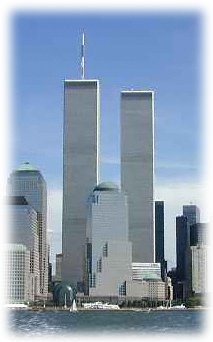
Everyone talks about their last sighting of the twin towers. Mine occurred on 9/9/01 as I walked towards the elevated train that would take me from Brooklyn to Manhattan. The East River was only minutes away by train and as I looked towards the Western sky in mid-afternoon, I saw for the first time in my life the not-so-distant twin towers. I had never thought to look at them from Brooklyn. I'm glad I got one last chance. I admired their colossal size that even from Williamsburg, Brooklyn, they were close enough and could just as easily have been in Brookyn itself.

Later on that afternoon, I was dazzled by a state-of-the-art living-theater panorama with electronic music swirling as the digital images of cityscapes and people, flitting across streets and plazas, created a memorable art montage in a multi-media exhibit of the old Museum of Modern Art. I smiled and felt thankful that I was able to see early 21st century art in my favorite art venue in New York City. I looked forward to my next visit to that city and that temple of art. Little did I know that I would never see that city or that art-for-art's sake environment ever again. No one would.

While watching the semi-fictionalized mini-series, The Path to 9/11, in spite of its controversial build-up, I felt, not hopeless, but a bit frustrated as to what one person could do to deal with the continuing aftermath of 9/11, as well as how to prevent it from ever happening again. It is something that all good people of faith can do. I say it in the following way because I am a Christian and this is what gives meaning and hope to my life. If you are not of my faith, I hope you can find a comparable set of goals to complement my life-affirming approach.

I am attracted to the number three because of it's trinitarian qualities. Therefore, the only three realities that are my tools for suriviving and changing myself and my world are these.


  1. Dedicated and meaningful study of the Word of God (Old and New Testaments)
  2. Seeking for Righteousness by faith in Christ Jesus
  3. Seeking for the baptism and continued infilling by Jesus Christ of the Spirit of God, the Spirit of Christ, the Holy Spirit

It is my conviction that with these three realities in my daily life, a repeat of the tragedy of 9/11 cannot only be prevented, but spiritually reversed, as well.

If we allow ourselves to be changed through these three realities, then we in and of ourselves become a positive force in the world and for God, the God of peace and life and love. We then effect at least one other person with the results of these three realities. They in turn effect someone else. This endless effect and re-effect can never cease, as a rolling stream can do nothing but seek its outlet in the sea. Year after year, this positive force for goodwill will relentlessly counteract the damage done, and prevent future damage from ever rising again. The power of a genuinely loving individual connected to the source of infinite life is invincible against all systems of hate, death and war.

It is my sincere hope that at least one person will be receive a sympathetic effect from my bittersweet recollections of what was, but need not have been, nor need ever be again.

Saturday, September 09, 2006

Encounters with God

"Do not quench the Spirit." Thessalonians 5:19 (New King James Version)

Christ was so real that I sought him out often while at college by Thayer Pond in South Lancaster, Massachusetts. As I read the bible, I felt he was there with me.

A few years later, late at night lying sleepless in my bed at home in New York City on the 7th floor I felt I could reach out and touch God because he felt so near. It was eerie to realize that I was praying to a very real person, not just someone you read about only in books. He was palpably real and I was astounded with the realization late at night as the family slept in other parts of the apartment.

While reading the Beatitudes as I waited in a car dealership in Fort Lauderdale, Florida yesterday afternoon, I had this unusual and surprising image of my relationship with the Spirit of God, the Spirit of Christ, The Holy Sprit. It is not intended to offend anyone, especially the Person of the Holy Spirit. It was a very personal and delightful set of images and their essence lingers still.

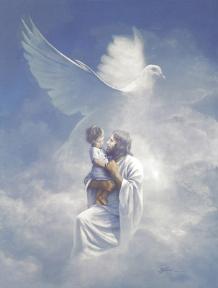
John the baptist, no doubt, saw the dove of light above Christ at the baptism. Christ, no doubt, also saw the dove. It was meant for both of them to see. Imagine yourself at the baptism and being allowed to see that wondrous image of a flaming dove that hovered with light in its wings.

The words about the Son of Righteousness with healing in his wings came to mind as did the text about Christ wanting to gather Jerusalem's people under his wings as a hen gathers her brood.

The song "Under His wings I am safely abiding" came to mind, as well. The text about God drawing us close to his bosom in the old testament came to mind, all in rapid succession.

Effortlessly, an image of a giant white dove with intelligence in his or her eyes, came to mind. I found myself drawn to seek shelter under the safety and warmth of that Compassionate Dove. When the dove moved I followed. If ever I momentarily moved outside to survey my immediate surroundings I always came back, more and more, to the shelter of the Wondrous Dove. When the situation got too dangerous where we were, I felt compelled to climb aboard the Dove of Strength and either hug its neck with both arms or held onto His strong and indestructible plumes.

Every day the dove took me higher and higher to greater and greater safety. Sometimes we would land, but as time advanced, I found myself safely under or flying with the Dove of Light, more and more. Finally, the Dove of Life landed in a wondrous place, and as I got out, I knew I was forever safe. I was home. Never to leave again. Never to fear again. Never to hide. I was safe in that world of light to walk anywhere possible, always conscious that I could not have gotten there had it not been for the kindness and protection of the Dove of Love.

"Under His wings, oh, what precious enjoyment!
There will I hide till life’s trials are o’er;
Sheltered, protected, no evil can harm me,
Resting in Jesus, I’m safe evermore." --William O. Cushing

Thursday, September 07, 2006

Cleansing Lakes of Fire and Water

Hotter version: Our God is a consuming fire. God is love. Love is a consuming fire. Death and Hades were thrown into the Lake of Fire. Love is the Lake of Fire. ... a sea of glass, mingled with fire... standing on the sea of glass (the Sea of Love.) Is this Sea of Glass mingled with fire what remains of the Cleansing Lake of Fire? Or are they different bodies of heavenly fire? It is strange, perhaps shocking, to think that the light that would cause eternal day to exist is the same light that the unrepentant wish to hide from. They call upon the rocks and mountains to fall upon them (instant death) and hide them from the splendor of Him that sitteth on the throne and from the wrath of the Lamb. It would be nice if the "smoke of their torment ascendeth up forever and ever" instead of meaning, as some have explained it, that the consummation is final and not everlasting suffering and punishment, it meant something else. Something finer, though without its problems.

If you have a very difficult child who hated you no matter what you did, but being his or her parent, you persisted in loving that child. If the state gave you the ultimatum of giving the death sentence to your own flesh and blood, or you continuing to love and, refashion that troubled and corrupt person, wouldn't the latter be the more loving for you, his parent to do? Does God stop loving the unrepentant sinner as they are cleansed in the Lake of Holy Fire? It is with understandable pain that the cleansing fire begins to do its devastating work. Could perfect love and its attendant holy fire not eventually work its miraculous change in the hating and hateful sinner to eventually restore the beauty of holiness and love in him or her after a renewing process? Is there such a thing as a truly unredeemable person? While I'm not saying all will be rescued from being eternally lost, I am saying all could be salvaged, as you would salvage the precious photographs left after a devastating fire, or destructive hurricane.

We've all known and know about truly evil and hateful individuals, I will not call them "persons," that is saved for people with some degree of humanity. Evil really is the worst form of mental illness or bodily illness there is. I don't say this to excuse "evil" individuals but to try to understand how or why someone came to be in such a deplorable state. Would not a loving God, because He loved that "dyed-in-the-wool" individual, be doing that person a great favor by slowly, even if painfully, removing the evil stain from the heart and mind, until the original childlike innocence could resurface again, and mature in a better environment with more nurturing people and circumstances? In this way, couldn't everyone eventually be renewed, and wouldn't they be grateful? I know of drug addicts or alcoholics who think they are fine the way they are, and don't want to be helped, because they don't realize how much better they would be if they were free of their addictions. But once helped, and reformed, how much happier and productive they would become.

If you love Him who first loved you, the nature of God will not terrify you, but fill you with awe and reverence. Our God is a consuming fire. If you hate Him who first loved you, God's nature will terrify you. "Fall on us and hide us from the face of Him that sitteth on the throne and from the wrath of the lamb. For the great day of his wrath is come and who shall be able to stand?"

These are not easy words to read or write, either for the believer, and especially for the unbelievers. But who are we, mortal beings, to question the will and nature of He who created everything that is, that was, and that is to be. "I am what I am. I will be what I will be. I will cause to be what I will cause to be."

Agnostics and atheists are no doubt applauding and shaking their heads in disbelief and dismay and disgust. Such is the nature of good and evil, of light and darkness, of life and death.

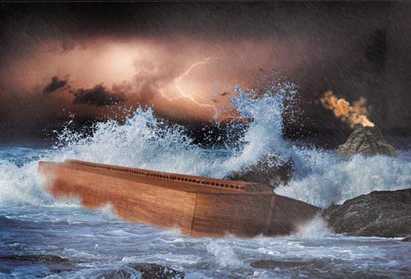
Cooler version: No matter how painful it may be to admit, or read, or ponder, "our God is a devouring fire." The God who needed to wipe out most of humanity with Noah's flood (whether it really occurred or not as a worldwide phenomenon) and the God who will plunge, if not most (only few find the straight and narrow road) then quite a lot of human beings into the cleansing lake of fire, is also the God who spared not His son and who will also give us everything. It tells you a lot about the person who in spite of painful images of past and future destruction of imperfect and recalcitrant human beings, still needs and wants to foster a faith relationship with this wondrous being who both created us and is capable of destroying us. "Even though he slay me, will I still love Him." "I will not let go of You, unless You bless me." "The Lord chastises those he loves." It's a bewildering type of apologetics. Were it not that we're talking about the author and finisher of our faith, we would have long ago abandoned him, and looked elsewhere. Our faith and life, as well, is full of oxymorons. I'm suddenly reminded of an odd statement by an Argentine pastor when I was a boy. He sometimes cursed his fate that he wasn't born on one of the many sinless worlds. I thought it peculiar that anyone would even think of such a preposterous wish. I hope we all get our wish and are reborn on a perfect world someday and never remember our perplexing, though often bitter sweet life on planet Earth.

Saturday, August 26, 2006

Fear of the Holy Spirit

"Do not let your hearts be troubled. Trust in God; trust also in me [Jesus Christ.]" [Trust also in the Holy Spirit.]* John 14:1 (NIV)

“One would expect, therefore, that nothing would be more familiar to every Christian than the reality of the Spirit. But to the contrary, there is almost no other subject in modern theology so difficult to deal with as the doctrine of the Holy Spirit." 5

All our lives it was drilled into us that the unpardonable sin was grieving away the Spirit of God. Several approaches result from such a fear. One lives in a constant state of anxiety worried that too much sinning, or lack of devotion, or some incomplete knowledge of salvation might lead to the unpardonable sin.

Another result is fear of any type of emotional response to the Holy Spirit's work during evangelistic or worship services lest that heightened sense of emotion lead to a false speaking in tongues, which would automatically be labeled "not the work of the Holy Spirit."

Still another result is to have so much respect and awe and, yes, fear, that one thinks it best not to dwell on the subject of the Holy Spirit too often, or to speak of Him as little as possible, so as not offend, and therefore "sin against the Holy Spirit."

Perhaps there are other possibilities, but these will suffice to lead to the real reality of the Holy Spirit and His importance in our lives.

During one of the Sabbaths earlier this year when the church was studying the subject of the Holy Spirit, we asked the class if they thought it was proper to pray directly to the Holy Spirit and to worship Him directly? The question was shocking to most of those present. One woman even said that to worship and pray directly to the Holy Spirit was to make an idol of the Holy Spirit. We responded that it was impossible to do so, since being God Himself, one could not make an idol of Him by both worshipping and praying to Him directly. The rest of the class then concurred that what was accepable was to worship all three members of the Godhead equally and simulaneously, but not separately, if memory serves me. Regarding praying directly to the Spirit, all concurred that one had to pray to God the Father, in the name of Jesus, and through the Spirit.

Since "God is Spirit" and the Spirit is both the "Spirit of God" and the "Spirit of Jesus" would you not be worshipping and praying to the Godhead by worshipping and praying to the Holy Spirit directly? Being Spirit in its Quintessence, are not all members of the Godhead embodied in the Divine Spirit? When we pray, love, worship and meditate on the Holy Spirit, are we not concurrently doing all these devotions to God the Father and God the Son? Do you think the first and second persons of the Godhead mind that you pray to the Spirit in this, the final age of man, the Dispensation of the Holy Spirit? How much more holiness, love and power would there be if the Spirit were constantly being invoked, praised, honored, talked about, and loved?

In the church hymnal there are very, very few songs exclusively devoted to the Holy Spirit. Of the few there are, only one was familiar to me from all the songs I've ever heard sung in an Adventist Church. That song was one made popular in the 70s by the Heritage Family with words that said, "There's a sweet, sweet Spirit in this place. And I know that it's the Spirit of the Lord." Since the Spirit is our mainline to God and our only hope of getting with God and staying with God, why are there so few songs in the Hymnal? And why are those songs sung so infrequently? Is it because if they are sung the members will get too emotional and former members who "spoke in tongues" will get the urge to do so during Sabbath morning services?

I once witnessed two former pentecostal members of my Spanish congregation in the early 70s briefly get emotional during Wednesday night prayer meetings. One woman knelt with all others during a special altar call and directly addressed Christ with language so poetic and powerful that she stood out among your usual and "orthodox" prayer meeting devotee. The others didn't follow her example, but something very unusual was happening. So much so, that the miniser with a smile of awe that I've rarely seen in an adventist church, said, "Let's keep calm, because the Holy Spirit is defintely visiting us at this moment, right here right now." It almost seemd that by his fascination with what he and all present were witnessing, that he had seldom been at such occurrences within the Adventist church. It is one of the most singular memories I have of Adventism, the Holy Spirit, and a minister's cautious counsel.

We as a church have not paid enough attention to the Holy Spirit, his reality, his ministry, his person, his beauty, his friendliness, his promise. It is a real shame that, instead of being known as those folk who focus on the sanctuary, 1844, the investigative judgment, and the prophecies of Daniel, we're not known as the "Church of the Holy Spirit." Were that the case, we'd have the tools and the power to fight post-modernism, secularism, apostasy, worldliness, bickering, contentiousness, selfishness, sensuality, smugness, pride, a superiority complex caused by an obession with our being the Remnant Church of the Last Days, unChristlikeness, and just plain insensitivity to those inside and outside of the church who are hurting, lonely and in need of a helping hand.

May God have mercy on us and help us to think more about, pray more to and love Him more. I'm speaking of the Spirit of God, the Spirit of Christ, in a word, our Saviour, our God and our Friend, the Holy Spirit.

* It seems appropriate now to complete Christ's command to believe in all persons of the Godhead in this well-known verse. Jesus could not very well have included instructions to trust also in the Holy Spirit at the time He said these words since the outpouring of the Holy Spirit had not yet occurred.

Friday, August 18, 2006

Two Million, Three Hundred Thousand Years

While it makes for interesting, and some would insist historically important, Bible study, and, no doubt, it enrichens one's understanding of God and a host of other aspects of soteriology, I, for one, lose very little sleep worrying about the 2,300 days, years, or millennia.

Years have come and gone without those words crossing and recrossing my mind. Through the dark days that have come and gone, only Christ and his ever-present reality have been both in the forefront, as well as, in the back of my mind.

Whenever I happen to note other religious traditions and their detailed and exacting studies, reinterpretations, and endless quibbling of fine-haired details, I'm relieved to thank God for the beautiful simplicty of righteousness by faith in Christ Jesus.

So much time and effort is spent on rehashing all these dates, and possible interpretations and whether this person is right, or if they aren't how can they still call themselves Adventist, or Christian, or Spiritual. Why not give it a rest? That's right. Declare a moratorium, or a Sabbath Rest, that lasts longer than anyone has ever dared. Why not concentrate on more pressing matters, such as receiving and continuing to receive the Holy Spirit? Once more and more believers are filled with the heavenly comforter, all these dates and problems with dates, or with horns, or with places, times and reinterpretations will vanish. How I long for the simplification of Christianity. How far we've gotten from the apostolic church and their one-big-family style of worship and fellowship. We've unncessarily made Christianity into something as complex as are other tradition-obsessed schools of thought and practice.

Let's keep it simple, like Morris Venden suggested, salvation in a nutshell: "Pray to God, study His word and work with Christ." "...Apart from me [Christ] you can do nothing." John 15:5 (NIV) & "I can do everything through him [Christ] who gives me strength. Philippians 4:13 (NIV)

Or as John Keats once said, “Beauty is truth, truth beauty – that is all you know on earth, and all you need to know.”

Thursday, August 17, 2006

Aesthetics of Decadence and Violence

"Finally, brothers, whatever is true, whatever is noble, whatever is right, whatever is pure, whatever is lovely, whatever is admirable—if anything is excellent or praiseworthy—think about such things." Philippians 4:8 (New International Version)

Are you tired of serious or quality films that while, ostensibly, are not junk as far as their artistry is concerned, nevertheless, their themes of violence, lust, twisted sexuality (necrophilia, voyeurism, sado-masochism), and their obsession with just plain appalling people whom you'd never want to bring home to your house or would feel comfortable visiting theirs, makes you long for a new cinema, one of decency and gentleness? While such anti-cinema-verite films may be useful to give you a point-of-reference when talking to both Christian and non-Christian lovers of serious film as Francis Schaeffer recommended in Escape from Reason, it is becoming increasingly distasteful to continue being "in the know." While the same thing could be said for significant literature and the arts in general, the medium of film with its alternate universe and in-your-face palpability, invades not only your mind for two hours, but your life, as well, with a lingering residue that lasts days or weeks or years, down the road. Even though I've only seen Silence of the Lambs once, years ago, its deadly world of misery and vileness reappears briefly whenever the title flashes across any history-of-film newspaper article or in a chance sighting on the DVD shelves of a library or store.

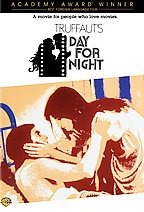
While the films that were then-current with the intellectual set when Schaeffer wrote his Escape from Reason, such as Satyricon or Day for Night were, no doubt, equally as offensive to some lovers of serious film, whether Christian or non-Christian, they seem almost wholesome in comparison to the movies of the 90s and of the first decade of the 21st century. The former, while containing some decadent and historically-correct violent images, left much to the imagination and were metaphorical in their use of images and motifs, as opposed to today's no-holds-barred approach. In spite of some of their themes being objectionable, the total effect of each film focused on the power of art and memory to enhance, instead of vitiate, the lingering effect of one's celluloid encounter.

Needless to say, some future film afficionado may one day look back upon Sin City and Kill Bill, Volume 1 and find them strangely nostalgic of a simpler time. It's painful to even imagine what those future serious films will be like, that will render these contemporary films agreeable and reminiscent of days gone by.

"By beholding we are to become changed; and as we meditate upon the perfections of the divine Model, we shall desire to become wholly transformed, and renewed in the image of His purity. It is by faith in the Son of God that transformation takes place in the character, and the child of wrath becomes the child of God..." –Elen G. White, 1st Selected Messages 335-338 (Signs of the Times December 26, 1892).

Saturday, August 05, 2006

To Be a Rock, but Not to Roll

"And will not God bring about justice for his chosen ones, who cry out to him day and night? Will he keep putting them off? I tell you, he will see that they get justice, and quickly. However, when the Son of Man comes, will he find faith on the earth?" Luke 18:7-8 (NIV)

Even John the apostle was mildly influenced in his choice of imagery, though not his theology, by the gnostics and their emphasis, or fascination with light. We're glad he was mildly influenced for the style of the Gospel according to John is light-years away from the synoptic gospels. We intend, needless to say, no disrespect for the beauty and simplicity of Matthew, Mark and Luke. John did not write or live in a cultural and intellectual vacuum. His marvelous writings, including the often-shocking Revelation with its visions of lakes of sulfuric fire and cities of transparent light, were not written in a cultural or intellectual vacuum, though the Apocalyptic book was, of course, written in the apparent cultural isolation of Patmos' confinement.

Modern Christianity is necessarily colored by its time and its intellectual or cultural movements, as well. We have memories of Christians and Christianity through the kaleidoscopic lens of the Summer of Love. Again, no reference is intended by "kaleidoscopic" to most Christians necessarily taking psychedelic agents which colored their views of their religion. I, myself, was a church-going teeny bopper who was both afraid, but not ignorant of what others, both within and outside the church were doing with mind-expanding drugs. Nevertheless, we're reminded by now-forgotten accounts of pre-conversion encounters with God through Lysergic Diethylamide Acid (LSD), as well as, Cannabis (Marijuana.) Some of these accounts were of recently-converted first year theology students who had been tripping months prior to their conversion, or of late-70s or early 80s inner-city gang members whose first encounter with what later became correctly identified as God, was initially perceived through chance Cannabis-altered consciousness.

Might today's young adults, 30-somethings, and all other post-Woodstock generation individuals, whether generation-x, y, z and beyond, especially the Myspace.com generation, not also be influenced in their perception of Christianity through the cultural influences of the Worldwide Web, MTV, and the musical-cultural-cinematic excesses of their youth and early adulthood? Do they read the Bible or the related writings of their Christian founders, Mary Baker Eddy, Joseph Smith, Ellen G. White, differently than do their pre-Gen X fellow Christians?

What about the aging Beat-era Christians? I met two or three Christian educators who had a mild awe of Kerouac, Ferlinghetti and the Cool Jazz Scene, though not of Ginsburg's Howl, when I was a student at an Adventist college in the 70s. Did their 50s-beat sensibility color their perception of art, culture and religion, in ways that were necessarily different than the Flower generation? No doubt, Beat-influenced Christians had more in common with the Woodstock generation Christians, than the latter group has with the odd apathy or nihilism of the Gen-X influenced Christians and beyond.

What about the "What the Bleep Do We Know?" flavored Christians of today and their descendants? Will their perception of Christianity be as alien to their parents as the Woodstock-era Christians were to their parent's Christianity?

Nevertheless, are there no takers for pure, undiluted, old-time religion, Christianity, or spirituality? Or is that a distant memory or theory or future development as the "End of Time" takes place, if it has not already taken shape as we write?